
Networking and infrastructure
Our expertise includes structured cabling, server management, wireless solutions, and real-time monitoring, ensuring seamless connectivity and robust performance to keep your operations running smoothly. Trust RK Black for dependable infrastructure solutions.
Building Reliable Foundations for Business Success
Whether you’re a small business or a large enterprise, we deliver customized solutions to meet your unique needs.
A well-built infrastructure directly affects system reliability, network performance, and how securely your IT & security solutions operate across daily business operations. For many businesses, this foundation is part of a larger IT & security solutions approach that connects infrastructure performance with protection, reliability, and long-term support.
Comprehensive Networking Solutions
At R.K. Black, we specialize in designing, implementing, and managing advanced networking systems tailored to your operations. Our networking services include:
- Network Design and Installation: Create a secure and scalable network architecture to support your current and future needs.
- Wireless Networking: Implement reliable Wi-Fi solutions for optimal connectivity across your workplace.
- Switching and Routing: Efficiently direct network traffic with high-performance switches and routers.
- Network Security: Protect your data and devices with robust firewalls, intrusion prevention systems, and encrypted connections.
Infrastructure Services for Modern Businesses
Your IT infrastructure is the backbone of your organization. R.K. Black offers infrastructure services that enhance performance, scalability, and resilience:
- Server Installation and Management: Set up and maintain on-premise and cloud-based servers to handle your applications and data.
- Virtualization Solutions: Optimize resource utilization with virtual servers and desktops, reducing costs and improving flexibility.
- Cloud Integration: Seamlessly connect your infrastructure to cloud platforms, enabling remote access and collaboration.
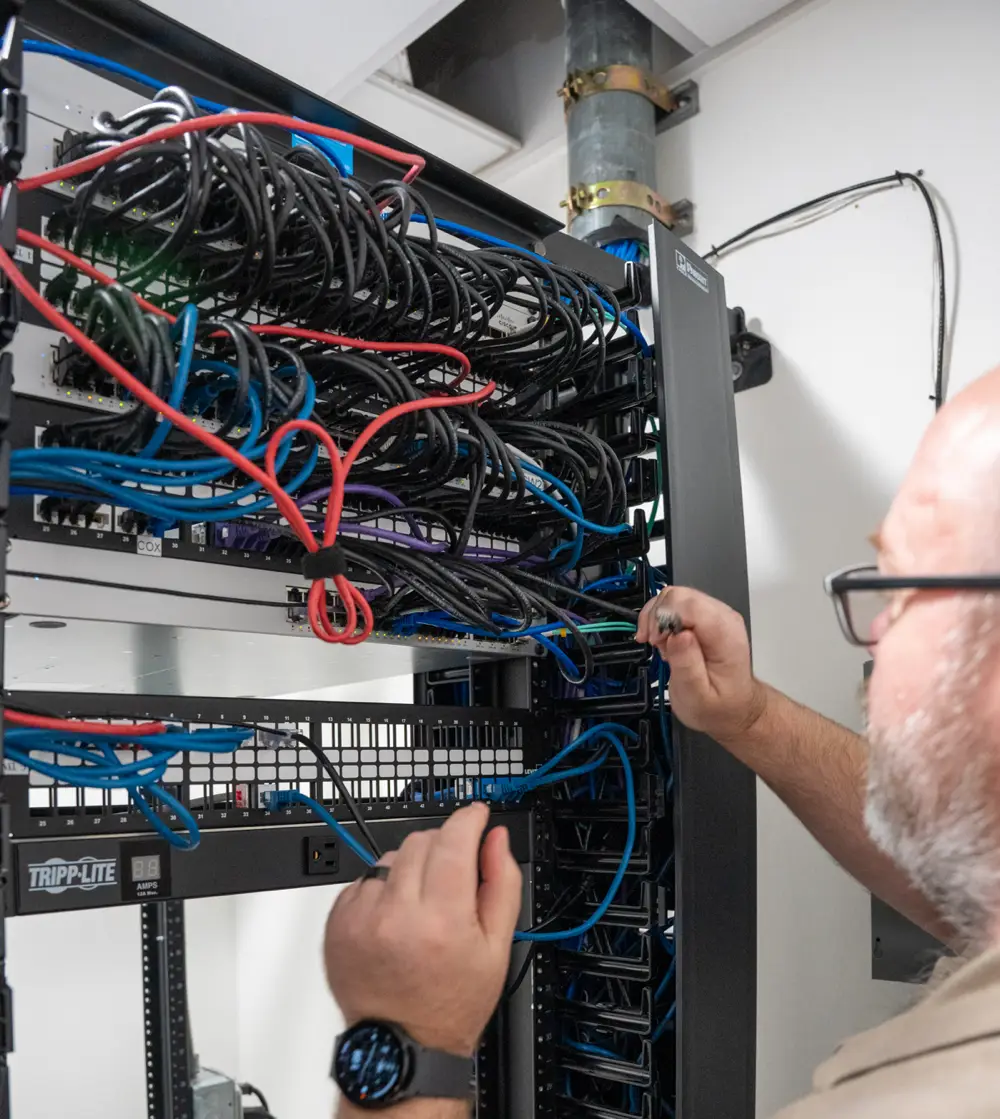
- Structured Cabling: Design and install organized cabling systems for faster data transmission and easy scalability.
- Disaster Recovery and Backup: Protect your critical data with automated backups and recovery solutions to ensure business continuity.
Why Choose R.K. Black?
- Tailored Solutions: We analyze your business requirements and deliver customized networking and infrastructure solutions.
- Expert Team: Our experienced technicians and engineers provide professional design, installation, and ongoing support.
- Reliable Support: With proactive monitoring and fast response times, we ensure your network and systems operate without interruption.
- Cost-Effective Options: We focus on delivering solutions that maximize value and minimize downtime.
Stay Connected, Stay Competitive
Contact Us For IT Security Services

Frequently Asked Questions About Networking & Infrastructure
What is Network Infrastructure?
Network Infrastructure comprises the hardware and software resources enabling connectivity, communication, and management across all systems within an organization. This includes routers directing traffic between networks, switches connecting devices within networks, wireless access points providing Wi-Fi connectivity, firewalls protecting against threats, and cabling creating physical connections.
Think of Network Infrastructure as your organization’s circulatory system—it connects every device and enables information flow between users, applications, cloud services, and resources. Reliable infrastructure ensures smooth business operations while poor infrastructure creates frustrating bottlenecks, frequent disruptions, and security vulnerabilities that attackers exploit.
What is Network Infrastructure Security?
Network Infrastructure Security protects core networking components from attack, unauthorized access, and configuration tampering. This includes securing routers and switches with strong authentication and encrypted management access, segmenting networks to contain potential breaches, implementing access controls limiting which devices can communicate, and encrypting sensitive traffic.
Infrastructure Security also addresses physical security of networking equipment in wiring closets and data centers, timely firmware updates patching vulnerabilities, continuous monitoring for unauthorized changes to network configurations, and network access control systems verifying device compliance before allowing connection. Compromised infrastructure devices provide attackers access to all network traffic and connected systems.
What is Network Infrastructure management?
Network Infrastructure Management encompasses monitoring, configuring, optimizing, and maintaining networking components to ensure reliable performance, security, and capacity. This includes tracking device health and performance metrics, analyzing traffic patterns to identify bottlenecks, managing configurations consistently across devices, and planning capacity upgrades before constraints impact operations.
Proactive management identifies performance degradation before it affects users significantly. Configuration management maintains consistency across devices, documents network architecture comprehensively, and enables rapid recovery from failures through automated restoration. Performance monitoring provides data driving optimization decisions and capacity planning, transforming networks from sources of problems into reliable business enablers.
Why is Network Infrastructure important?
Every business application, communication tool, and digital process depends fundamentally on network connectivity working reliably. Unreliable infrastructure causes frequent disruptions, frustrated users unable to work effectively, and lost productivity that directly impacts revenue and competitive position.
Beyond basic connectivity, infrastructure quality affects application performance—slow networks hamper efficiency across the organization and limit what cloud applications can accomplish effectively. Security depends heavily on infrastructure design and implementation, as poor network architecture creates vulnerabilities difficult or impossible to mitigate through other means. Strategic infrastructure investment enables new business capabilities while inadequate infrastructure constrains options and competitive responses.
What is Network Design and Implementation?
Network Design and Implementation covers the complete lifecycle of building or upgrading networking infrastructure from initial planning through production deployment. The design phase assesses current and anticipated business requirements, selects appropriate technologies balancing performance and cost, maps physical and logical network topology, and plans comprehensive security architecture.
Implementation involves procuring equipment meeting design specifications, installing cabling infrastructure, mounting and configuring network devices, establishing security controls, and conducting thorough testing validating functionality. Comprehensive documentation captures network architecture, device configurations, IP addressing schemes, and operational procedures. Final validation ensures the network performs as designed before declaring projects complete and transitioning to operational support.
Why is Network Design so important?
Network Design fundamentally determines what applications your infrastructure can support effectively, how securely it operates against evolving threats, how reliably it performs under normal and peak loads, and how efficiently it uses resources. Poor design creates performance bottlenecks limiting productivity, security vulnerabilities that attackers readily exploit, and single points of failure causing widespread outages.
Retrofitting poorly designed networks costs far more than investing in proper initial design—both in direct expenses and business disruption during remediation. Growth beyond original design capacity requires expensive infrastructure overhauls. Strategic design anticipates future business needs, incorporates industry best practices and lessons learned, and creates stable foundations supporting years of reliable operation and business growth.
What is Wireless Networking?
Wireless Networking uses radio frequencies to connect devices without physical cables, providing network access throughout coverage areas. Wi-Fi access points connect to wired network infrastructure and broadcast signals that computers, phones, tablets, and IoT devices detect and use for connectivity.
Modern wireless networks support speeds comparable to wired connections—often exceeding 1 Gbps—while enabling mobility throughout coverage areas that physical connections cannot match. Enterprise wireless systems manage dozens or hundreds of access points, ensuring seamless connectivity as users move between areas, balancing load across access points, and maintaining security against unauthorized access and eavesdropping.
How does Wireless Networking work?
Access points connect to wired network infrastructure and broadcast radio signals on specific frequencies that wireless devices detect within range. When devices enter coverage areas, they identify available networks and request connection credentials.
After successful authentication verifying authorization, access points assign devices network addresses and enable full network communication. As users move through buildings or campuses, devices automatically hand off between access points, maintaining seamless connectivity without user intervention. Centralized controller software coordinates multiple access points, manages security policies consistently, optimizes channel selection avoiding interference, and provides visibility into wireless network performance.