

Physical mail hasn’t gone away. Invoices, statements, notices, contracts, appeals, marketing pieces, court filings, patient communications, and regulatory correspondence still move by mail in enormous volumes across every industry. The volume shows up on the operations side as labor, on the postage bill as expense, and on the budget as one of those line items that quietly grows year over year without anyone quite knowing why.
Mailing systems exist to bring structure to that volume. Instead of treating outbound mail as a manual, ad-hoc process — stamps, envelopes, trips to the post office, occasional runs to buy toner for the label printer — a proper mailing systems setup automates the preparation, meters the postage, standardizes the addresses, tracks the pieces that need tracking, and captures the USPS discounts that the volume qualifies for.
For organizations weighing whether their current mail operation is quietly costing more than it should — or whether it’s time to modernize equipment that’s been sitting in the same corner for a decade — understanding what mailing systems actually cover is the starting point.
What Mailing Systems Actually Mean
A mailing system is the combination of equipment, software, and services that manages a business’s outbound and inbound mail operations. As one of the six primary types of managed services, the category spans postage meters, folder inserters, addressing equipment, mailing software, and the ongoing management that keeps all of it operating efficiently. A small business might need only a postage meter. A high-volume operation might have an entire mailroom with automated folder inserters, tabbers, sealers, and CASS-certified address software feeding into every step.
What distinguishes a real mailing systems program from ad-hoc mail handling is the integration between components and the operational efficiency that emerges from bringing them together. Postage that’s metered rather than stamped costs less. Addresses that have been standardized and verified cost less to mail and don’t come back as undeliverable. Presorted mail costs less than unsorted mail. Certified mail that’s tracked electronically eliminates the phone-tag when a recipient claims they never received it.
What makes mailing systems distinct from the other managed service categories is the focus on physical infrastructure — the equipment that folds, stuffs, addresses, meters, and moves paper mail — combined with the software and USPS integration that makes the infrastructure operate at maximum efficiency. For businesses running our mailing systems alongside managed print or document management, the three service lines integrate naturally into a unified document lifecycle.
How Mailing Systems Differ From DIY Mail Handling
Most businesses start out handling mail the manual way. Stamps get bought at the post office. Envelopes get stuffed by whoever has time. Address labels get printed off a laser printer. Certified mail requires a trip to the counter. This works when mail volume is low and the business has more time than money, but the model doesn’t scale — and it leaves real cost on the table even at small volumes.
Three approaches typically emerge as businesses grow.
Manual mail handling relies on stamps, hand-addressed or basic-printed envelopes, and trips to the post office for anything unusual. Costs are unpredictable because postage rates change and nobody’s really tracking usage. Certified mail requires physical trips. Presort discounts are unavailable. Addresses get manually retyped, with the errors that come with that.
Basic postage meter setup brings postage in-house through a rented meter but stops there. The business avoids the trips to the post office for standard mail, but the folding and stuffing is still manual, addresses aren’t verified against USPS databases, and any volume-based discounts on presort or destination entry go unclaimed. This is where most businesses live — and where the most money tends to get left on the table.
A managed mailing systems program pulls it all together. Metered postage, automated folding and inserting for volume, CASS-certified address software, presort processing when volumes justify it, electronic certified mail tracking, and the ongoing service that keeps the equipment running through USPS rate changes, hardware refreshes, and workflow evolution. The model doesn’t just save time — it captures postal discounts and reduces address errors in ways that pay for the equipment several times over at typical volumes.
What’s Included in a Mailing Systems Program
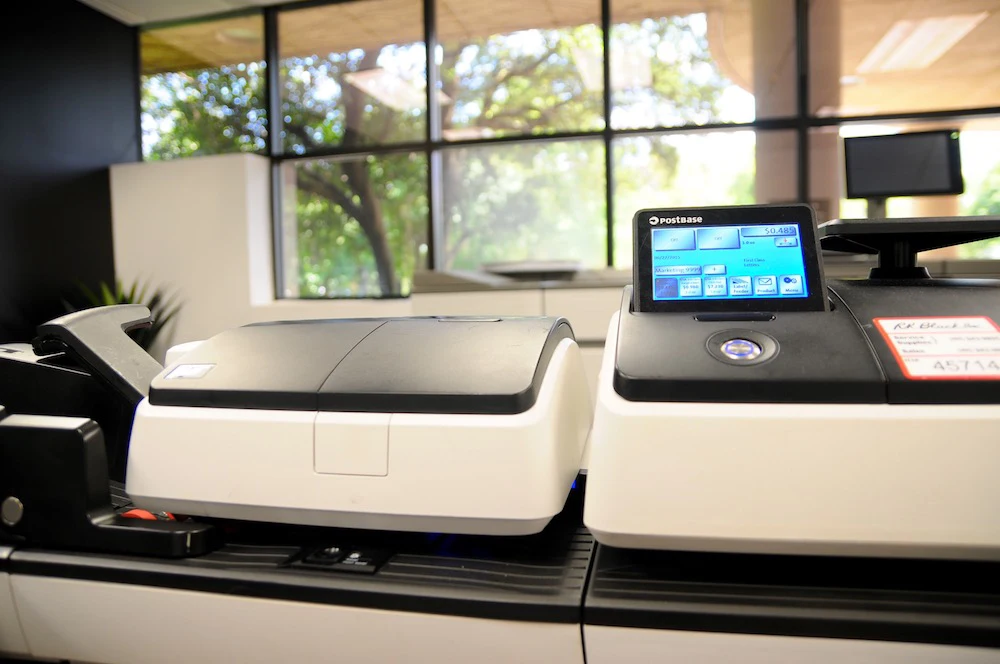
The scope varies with mail volume and business needs, but a comprehensive mailing systems engagement typically covers six core areas.
Postage Meters and Postage Management
The foundation for most businesses. A postage meter prints digital postage indicia directly onto envelopes, eliminating stamps entirely. Modern meters connect to USPS systems automatically, refill postage funds electronically, print variable rates based on the exact class and weight of each piece, and produce reports that make postage spending visible for the first time.
The right meter depends on volume. A low-volume office might process a few hundred pieces a month on a compact desktop meter. A mid-volume operation might run several thousand pieces daily on a mid-range meter with an integrated scale. High-volume operations often run production-grade meters capable of tens of thousands of pieces per hour. Meter rental versus purchase, service contracts, and rate updates handled by the provider all factor into the total cost of postage ownership.
Folder Inserters and Mailing Automation
Manual folding, stuffing, and sealing is one of those tasks that consumes disproportionate amounts of labor for how mundane the work is. A folder inserter automates the entire sequence — pulling a document from a stack, folding it, matching it with any inserts (return envelope, promotional flyer, additional pages), inserting the assembled contents into an envelope, and sealing the envelope shut. Higher-end machines add tabbers for self-mailers, matched-content processing (each envelope gets the correct personalized contents), and integrated printing.
The economics tip in favor of automation earlier than most businesses expect. Even a few hundred pieces a week can justify a basic folder inserter, and volumes above a thousand pieces weekly almost always show a meaningful payback. The labor savings tend to be more visible than the equipment cost, but the accuracy improvement — no more stuffing the wrong invoice into the wrong envelope — often matters even more for businesses handling regulated or high-value correspondence.
Address Management and Mailing Software
The software layer that turns raw address data into deliverable mail. CASS-certified address standardization corrects addresses to USPS format, adds ZIP+4 codes, and verifies deliverability. NCOA processing (National Change of Address) identifies recipients who have moved and updates their addresses to current locations. Address hygiene tools flag duplicates, deceased individuals, and undeliverable addresses before the pieces get produced.
Beyond addressing, mailing software handles mail merge for personalized correspondence, database management for recurring campaigns, and the integration with accounting or billing systems that keeps address data synchronized across the business. For any operation sending recurring correspondence — statements, invoices, appeals, notices — proper address management pays for itself in reduced returned mail and improved deliverability alone.
Mail Tracking and Mailroom Workflow
The visibility layer for both outbound and inbound mail. For outbound, electronic certified mail replaces traditional green cards with digital tracking that produces the same legal proof of mailing and delivery, accessible through a web dashboard rather than a filing cabinet. Intelligent Mail Barcode tracking follows regular first-class mail through the postal system, giving businesses visibility into when their invoices actually landed.
For inbound, mailroom workflow software captures, digitizes, and routes incoming mail to the right recipients — often integrating with document management platforms to move mail directly into digital workflows. For businesses still receiving significant paper mail (which most still do, especially in regulated industries), the mailroom workflow layer is where paper stops slowing the business down.
Postage Optimization and Rate Strategy
The USPS offers substantial discounts for mail that meets specific preparation standards, but claiming those discounts requires knowing which apply, meeting the volume thresholds, and preparing the mail correctly. Presort discounts reward mail that arrives at the USPS pre-sorted by ZIP code. Drop-shipping discounts apply when mail is entered deeper into the postal network rather than at a local post office. Commingling — combining multiple businesses’ mail to hit presort thresholds — extends volume-based discounts to smaller mailers.
A mailing systems provider with real postal expertise identifies which discounts apply to a given operation, configures the equipment and software to prepare mail correctly, and often handles the presort processing as a service. The savings can be substantial and compound month after month, which is why postage optimization tends to be one of the highest-return components of any mailing systems program.
Direct Mail and Marketing Mail Services
The intersection of mailing systems and marketing. Direct mail remains an effective channel for certain industries and audiences — particularly financial services, healthcare, real estate, and nonprofit fundraising. A modern direct mail program combines variable data printing (each piece personalized with the recipient’s name, account information, or other data), quality production, presort processing, and response tracking to measure campaign performance.
Marketing mail — formerly called “standard mail” — has its own USPS rules, rate structures, and preparation requirements. A mailing systems provider that handles marketing mail brings both the equipment for producing it and the operational knowledge for navigating USPS requirements: indicia compliance, mailing statements, drop-ship coordination, and permit management.
Why Businesses Adopt Mailing Systems
The drivers vary, but a few patterns recur.
Postage cost tops the list at higher volumes. Businesses moving from stamps to metered postage typically capture per-piece savings on standard first-class letters that add up quickly at even modest volumes. Once presort discounts enter the picture, the savings on postage alone often justify the entire mailing systems investment.
Labor cost is the second driver. Manual mail preparation consumes senior administrative time without producing proportional value. Automating folding, inserting, and addressing frees up the staff who used to do that work for higher-value activities. Most businesses adopting mailroom automation find that the labor freed up matters as much as the postage saved.
Address accuracy improvements show up on the returned mail side. Undeliverable-as-addressed mail costs the business twice — once to send, once to process the return. Address standardization and NCOA processing dramatically reduce return rates, and the compound effect over months of mailings adds up to meaningful savings for any business with significant outbound volume.
Compliance and audit-readiness matter for regulated mail. Healthcare practices sending HIPAA-protected correspondence, financial services firms sending regulated notices, and legal offices handling court filings all benefit from the audit trails, delivery confirmation, and workflow controls that modern mailing systems provide. The documentation is often required; a mailing system produces it as a byproduct of normal operations.
Time to delivery improves as processes tighten. Mail that’s produced, sorted, and dropped efficiently reaches recipients faster than mail that spent three days in the outbox waiting to be processed. For invoices and statements, faster mail turns into faster cash flow. For notices with response deadlines, faster mail translates to more time on the recipient’s end and fewer complications.
Common Mailing Systems Pricing Models
Mailing systems are priced in a few distinct ways depending on the components involved.
Equipment leasing dominates most engagements. Meters, folder inserters, and mail production equipment are typically leased on multi-year terms with the lease covering the hardware, meter rental fees to USPS, ongoing service and maintenance, and usually consumables replacement. Leasing simplifies budgeting and eliminates the capital expense of owning equipment that has a defined useful life.
Cost-per-piece or transaction-based pricing applies for services like presort processing, address hygiene, and printing services that scale with volume. The model aligns provider incentives with the business’s actual mail activity rather than fixed monthly fees.
Software subscriptions cover the ongoing use of address software, mailing software, and mailroom workflow platforms. Most mailing software today is delivered as SaaS with per-user or per-transaction pricing tiers.
Hybrid arrangements combine equipment leases with software subscriptions and per-piece services for the volume components. For a mid-sized business, a typical mailing systems bill might include a base meter lease, folder inserter lease, address software subscription, and per-piece presort processing charges for high-volume mailings.
Whichever model applies, the questions stay consistent: what’s covered under the base fee, what triggers additional charges, how meter refills and postage funding work, what happens at renewal, and how the provider handles USPS rate changes.
When Mailing Systems Make the Most Sense
A few patterns make the case for a real mailing systems program especially strong.
Businesses sending significant outbound mail — invoices, statements, notices, appeals, marketing — benefit disproportionately, because the operational efficiency and postage savings scale with volume. Multi-location operations gain from centralized mail production that eliminates the redundancy of every location handling its own outbound. Regulated industries such as healthcare, financial services, and legal benefit from the compliance controls that come standard with well-managed mailing operations.
High-volume mailers with recurring campaigns — utility bills, insurance statements, subscription renewals, fundraising appeals — see the strongest financial case, because presort discounts and address hygiene compound month after month. Growing businesses justify mailing systems investments earlier than they expect, because the labor savings on manual mail prep tend to be underestimated.
The businesses where mailing systems are hardest to justify are very small operations sending mail infrequently and in small batches. Even there, a basic postage meter often pencils out — but the case for higher-end automation is closer.
Choosing a Mailing Systems Provider
The mailing systems market is smaller than adjacent categories like managed IT or print, but the differences between providers still matter. A few criteria help separate the right partner from the wrong one.
Postal Expertise and USPS Relationships
The USPS is a large, complex organization with rules that change frequently — rate updates, mail class changes, presort qualifications, indicia requirements. A provider that stays current with USPS changes and handles the compliance and rate-change work for clients delivers substantial ongoing value. Providers with formal USPS Business Mail Entry Unit relationships, presort licenses, and postal certifications typically have deeper expertise than those without.
Volume Fit and Equipment Range
Providers vary in the volumes they typically serve. Some focus on high-volume production environments; others focus on smaller offices with modest volumes. The right provider for a given business is one whose typical client profile matches — not too big (which usually means higher pricing than needed) and not too small (which usually means limited equipment options and expertise).
Software Ecosystem and Integration
Mailing systems that integrate with a business’s other software — accounting, CRM, billing, document management — produce more value than standalone equipment operating in isolation. Ask what integrations come standard, which require custom work, and how the provider handles the connections between the mailing operation and the rest of the business.
Service Response and Uptime
Mailing equipment that’s down stops mail from going out — which stops cash from coming in on any operation billing by mail. Service response times, on-site technician availability, and the provider’s track record for keeping equipment running all matter. Ask about typical response times, service call statistics, and how the provider handles hardware failures that can’t be fixed remotely.
Long-Term Partnership and Advisory Value
Mailing operations evolve. USPS rates change. New workflow opportunities emerge. Volume grows or shrinks with business conditions. A provider that acts as an ongoing advisor — recommending optimizations, flagging cost-saving opportunities, and helping the business adapt to postal changes — delivers more value than a vendor that installs equipment and disappears until renewal.
Seven Decades of Mail Expertise Across Oklahoma, Kansas, and Missouri
For more than 70 years, we’ve been helping businesses across Oklahoma, Kansas, and Missouri move information efficiently — through print, through digital channels, and through the mail. Our lineup spans Managed IT, Managed Cybersecurity, Managed Print, Managed VoIP, and Document Management, with mailing systems complementing all of them for businesses whose operations still depend on paper moving reliably.
As a family-owned operation, we approach mailing engagements the way we approach every service line: right-sized recommendations rather than oversized equipment, honest assessment of where automation will and won’t pay off, and the kind of ongoing partnership that’s still around when the USPS announces the next rate change or workflow evolution.
Technology fails. We don’t.
To explore whether a mailing systems program is the right fit for your business — or to map out a fuller technology strategy across multiple service lines — reach out for a conversation. A short discovery call is usually all it takes to identify where mailing systems would deliver the most immediate value.