
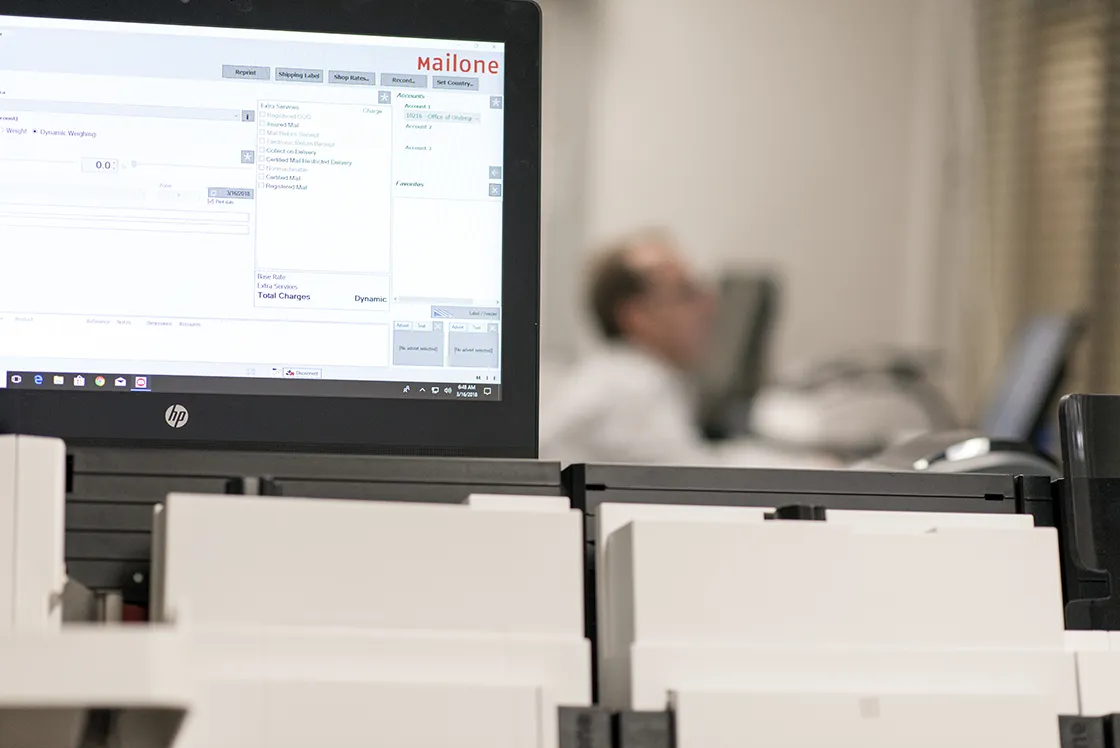
Every business sends mail. Invoices, statements, compliance documents, marketing pieces — the volume adds up faster than most teams expect. For organizations still processing outgoing mail by hand, that volume also adds up in labor hours, postage mistakes, and delays that could have been avoided entirely. An automated mailing system changes the equation.
At its core, automation removes the repetitive, error-prone steps from mail production and replaces them with a consistent, reliable process. Understanding how that process works — from data input to envelope in the mailbox — helps businesses make smarter decisions about their document workflows.
The Starting Point: Your Data
Before a single piece of mail is produced, an automated mailing system begins with data. Address lists, account records, and document templates are pulled from your existing business systems — whether that’s an ERP, CRM, or billing platform. The system reads this information and uses it to populate individual documents with the right recipient details, account numbers, balances, or any other personalized fields.
This step is where automation earns its keep. Manual mail production relies on someone to match the right document to the right envelope, and that’s exactly where costly mistakes happen. Automated systems handle matching with precision, every time.
Document Generation and Print Production
Once the data is in place, the system generates print-ready documents at scale. This isn’t simply printing — it’s optimized production. Pages are formatted to meet postal regulations, sorted by delivery route to qualify for postage discounts, and prepared as a continuous job rather than individual pieces processed one by one.
Modern automated mailing systems can handle variable data printing so each recipient’s document contains accurate, personalized information, USPS CASS certification and address correction to reduce undeliverable mail, presort processing to maximize postal discounts, duplex printing and page sequencing for multi-page documents, and barcode generation for mail tracking and piece-level visibility.
What would take a team hours to process manually moves through production in a fraction of the time — and with far fewer errors.
Folding, Inserting, and Sealing
After printing, documents move into the physical production phase. Automated folder-inserters fold pages to the correct size, insert them into envelopes, and seal everything without a single person touching each piece. High-volume inserting equipment can process thousands of pieces per hour, maintaining consistency that’s simply not achievable by hand.
This is where businesses often see the most dramatic time savings. A staff member stuffing envelopes is a staff member not doing something more valuable. Automation reclaims that time and redirects it.
Postage Application and Postal Compliance
Applying postage accurately is more complex than it looks. Rates vary by weight, size, class, and destination. An automated mailing system applies the correct postage for each piece, flags irregularities before they become problems, and ensures every mail job meets current USPS requirements.
Presort capabilities deserve special attention here. By sorting mail according to carrier route and ZIP code before it enters the postal stream, businesses can qualify for significantly reduced postage rates. For organizations sending thousands of pieces per month, those savings are substantial and recurring.
Tracking and Reporting
One of the most underappreciated advantages of an automated mailing system is visibility. Once mail leaves the building, businesses have traditionally had little insight into what happened next. Automated systems change that.
Using Intelligent Mail Barcodes and postal tracking integrations, businesses can see when individual pieces were delivered, identify undeliverable addresses, and generate reports on overall mail performance. That data becomes a feedback loop — improving list quality, catching address issues early, and giving managers the documentation they need for compliance or customer service purposes.
Where Document Management Meets Mailing Automation
Automated mailing doesn’t exist in isolation. It’s most powerful when it’s connected to the broader way a business manages its documents. When outgoing mail is treated as part of an integrated document management strategy — tied to digital workflows, archiving systems, and records management — the efficiency gains multiply.
That’s a philosophy RK Black has put into practice for businesses across Oklahoma, Kansas, and Missouri for more than 70 years. The goal has never been simply to sell technology. It’s to understand how information moves through an organization and ensure it moves better. Whether that means streamlining print and mail production, implementing a document management system, or managing the full scope of a business’s technology infrastructure, the approach stays the same: caring, integrity, and results that hold up.
Technology fails. RK Black doesn’t — and neither should your mail.
Ready to Streamline Your Outgoing Mail?
If your team is spending time on manual mail production that could be automated, there’s a better way. Contact RK Black today to learn how our document management solutions can improve your mailing process, reduce costs, and keep your business communications running without interruption.